SSI Night Diving Speciality Course in Andaman - What Comes Out After Dark
The diving doesn't stop when the sun goes down. Once it's dark, an entirely different cast of marine life comes out — creatures that spend the daylight hours tucked into coral, hunting or moving only after nightfall. Lobsters, octopuses, moray eels, rays, and species of barracuda and shark are all far more active at night than during the day, and the SSI Night Diving Speciality course is built to get you safely into the water to see it for yourself.
It's a different kind of dive. Your world shrinks to the beam of your torch, and you learn to plan and dive around conditions like disturbed sand, current, or just the dark itself. It can feel disorienting on your first night dive. Most divers fall in love by the second. I especially like diving on the no-moon nights — they bring out the bioluminescence, and it never stops amazing me.



What You Will Learn

The SSI Night Diving Speciality is built around 5 academic sections and a set of practical skills specific to diving after dark. You'll learn how to plan a night dive properly, how to use dive lights and read a specialised submersible pressure gauge and compass in low visibility, and how to deploy a surface marker buoy with attached signal light so the boat can track you.
You'll also learn night-specific communication — since the usual visual cues disappear once the sun's down — along with safe entry and exit techniques for getting in and out of the water in the dark.
Eligibility & Prerequisites
The SSI Night Diving Speciality requires decent control on your buoyancy and ability to navigate. I always recommend students get their Perfect Buoyancy and Navigation specialties done before they start this course.
You need to be at least 10 years old and hold an Open Water Diver certification (or its equivalent from another agency) as per international standard. You'll also need to be physically and mentally fit to dive — please check our medical questionnaire for more detailed information.
Price, Inclusions & Exclusions
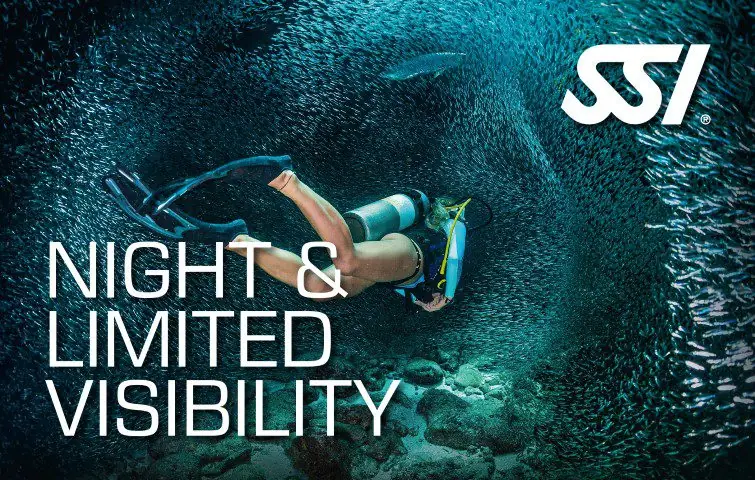
The Night Diving Speciality costs Rs. 14,000, excluding an additional 18% tax. The course runs across 2 full days and includes 2 night dives of 45 minutes each, at depths between 8 and 12 metres — shallower than standard daytime limits, for safety. One dive is a shore dive at Nemo Reef, and the other is a boat dive at Tribe Gate. You'll dive at an instructor ratio of 1:2, so you get close, personal attention throughout.
- Personal instructor (1:2)
- 2 night dives (45 min each)
- Boat transport for the Tribe Gate dive
- All rental equipment
- Certification fees
- Online study material
- Complimentary pick-up and drop
- Accommodation and meals
- Personal items like sunscreen or a swimsuit
For full pricing details, see our Rates & Packages page.
How You Learn the Night Diving Speciality!

Training for this specialty runs in two parts — theory first, then time in the water putting it into practice. We assign study material once you book the course, and you can complete that before you even arrive at Havelock. Once you're here, we run through it together, then move into the water.
It takes 2 evenings, with 3 to 4 hours of theory and practical combined, starting at 4:30 pm. The maximum depth for both training dives is 8 to 12 metres, shallower than standard daytime limits, kept that way for safety.
Being able to navigate using a compass, read a dive computer, and maintain stable buoyancy is a must before you start this course — we build your skill to dive in the night and limited visibility, but we may not sharpen the other skills that are required for this specialty too.
You'll carry two torches for every night dive — a primary light and a backup — and keep your main torch switched on before you even enter the water. While descending, you point your torch downward to check what's below you. While ascending, you point it upward to check what's above. Shining the torch toward your own chest reveals just how dark the water really is. Buddy communication doesn't change from day diving — you'll use the same hand signals you already know, just performed in your torch's beam so your buddy can actually see them.
One of the practical exercises is finding your buddy with your primary torch switched off. One of the instructors swims a few metres away from you, and you have to find them by pointing your backup torch toward your own chest — the beam reveals your position, and the instructor swims back into your light. It's a simple exercise, but it's built specifically to prepare you for the moment your torch goes out mid-dive and you need to reconnect with your buddy. I personally recommend never letting more than 1.5 to 2 metres separate you and your buddy, and always keeping count of your light beam underwater.
Beyond the two dive lights, you'll carry a compass, a marker buoy, and a slate. A few precautions apply specifically to night diving: avoid shining your torch into another diver's eyes; stay aware of surface light signals and use bearings or an illuminated shot-line buoy; and know that a strobe light or cyalume stick attached to your surface marker buoy helps the surface team track your position. A strobe light shone directly at another diver underwater can damage their night vision, so it's used with care.
Night diving carries a few risks that don't apply during the day, and part of the course is learning to manage them:
- Dive light failure — Losing your primary light can mean losing your visual references for depth and buoyancy, and makes it harder to read your dive computer, compass, or pressure gauge. This is exactly why a backup light is mandatory.
- Limited visibility — Staying close to your buddy and keeping your torch steady are the main ways to avoid getting separated in low visibility.
- Marine life behaviour — Nocturnal creatures like octopuses, lobsters, and stingrays are a big part of what makes night diving special, but some are more defensive or territorial after dark — we keep a respectful distance.
- Disorientation — Losing your sense of direction is easier at night without familiar visual landmarks; good navigation skills and a compass are the fix.
- Entanglement — Ropes, nets, and lines are harder to spot in the dark, so staying aware of your surroundings and keeping good buoyancy control matters even more. Carrying a knife is always a big help here.
- Equipment failure — Well-maintained gear and a proper pre-dive check reduce the chance of anything going wrong once you're in the dark.
I always recommend diving with a local dive guide, even once you've mastered the skills — a local guide knows the reef's currents, depth, marine-life behaviour, and weather conditions on any given night, and that knowledge is what keeps risk managed and the experience genuinely great.
Explore Other Specialties
Night Diving is one of several specialty courses we offer beyond the core certification path. It pairs especially well with Wreck Diving, since both require sharp navigation and buoyancy control in low-visibility conditions. Take a look at our full range of speciality courses to find what interests you next.
FAQs
Yes — you need an Open Water Diver certification (or equivalent) to join, and we recommend you're at least 10 years old. I also suggest completing Perfect Buoyancy and Navigation first, since night diving relies heavily on both.
That's exactly what the buddy-finding exercise trains you for. You always dive with a backup torch, and shining it toward your own chest reveals your position to your buddy so you can reconnect quickly and safely.
Nocturnal creatures like octopuses, lobsters, and stingrays are far more active after dark than during the day — species you're unlikely to spot on a daytime dive at the same site.
Night diving does carry specific risks — like limited visibility and disorientation — that don't apply during the day. With a backup light, proper buddy protocol, and a local guide, these are well managed and part of exactly what the course trains you for.
Each session runs from 4:30 pm, combining theory and the dive itself across 3 to 4 hours, with the dive starting once the sun goes down.
Ready to Dive After Dark?
Join the SSI Night Diving Speciality on Havelock Island and discover Nemo Reef and Tribe Gate the way few divers ever see them. Every move you make glows something around you — find out what they are!