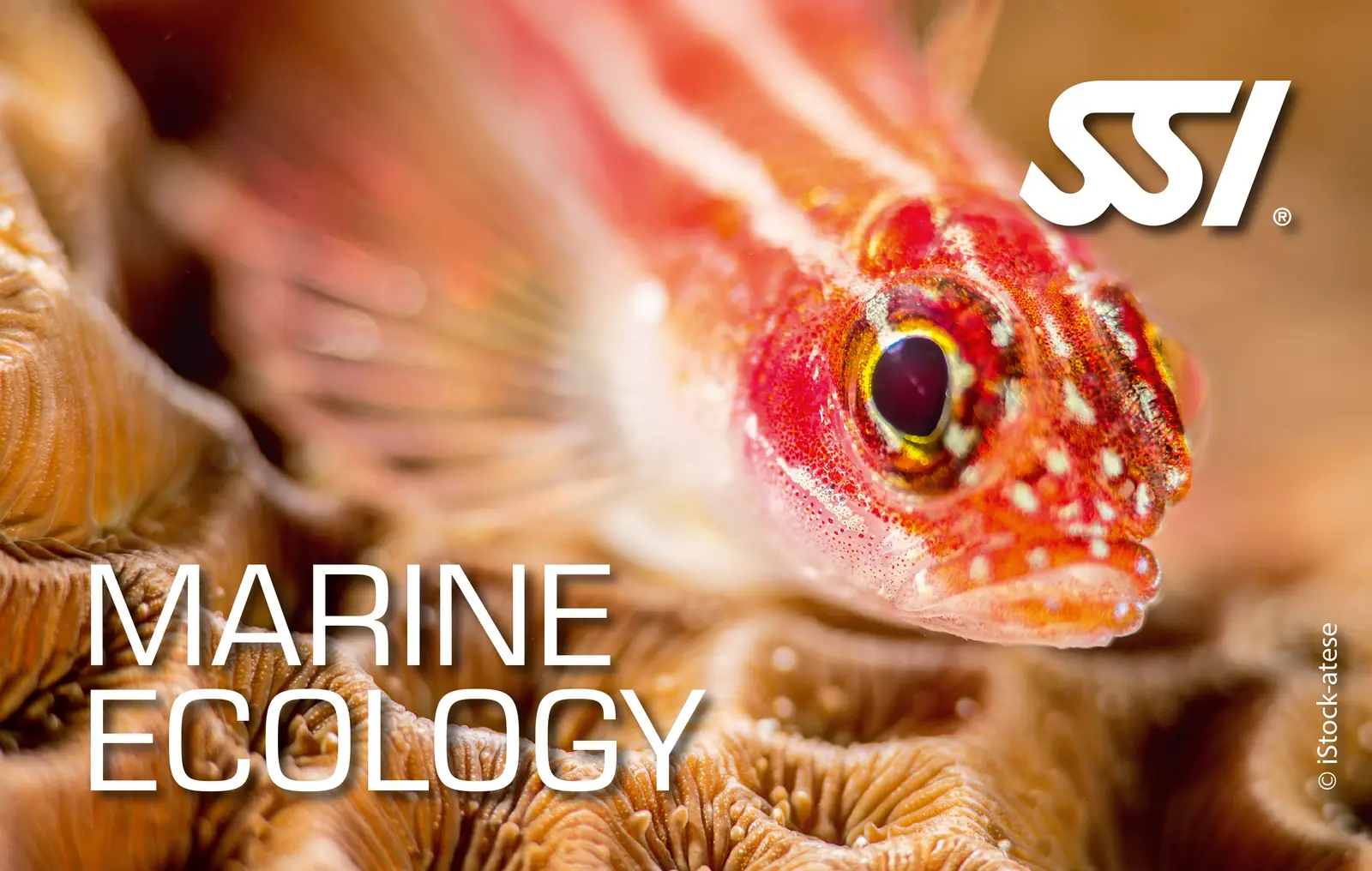
SSI Marine Ecology Course in Andaman - Understand What You're Diving Into
Most divers learn scuba to have fun underwater — and that's reason enough. But a few get curious about something else: why a clownfish lives inside a sea anemone that stings anything else that touches it except that clown fish, why a goby fish shares its burrow with a shrimp, why a cleaner wrasse can swim right up to a moray eel's mouth without getting eaten, why some creatures live alone and others move in tight schools. I have seen a giant puffer fish living silently in a corner, while aggressive trevallies are always chasing fusiliers on the same reef.
The SSI Marine Ecology Speciality builds real knowledge around those "why" questions — through academic sessions and through dives spent identifying and observing marine life up close, not just swimming past it. Over two dives at Dickson's Pinnacle and Nemo Reef, spread across two or more days depending on your pace, you'll start noticing what most divers miss.


What You'll Learn
Marine Ecology is split between academic sessions and in-water observation. In the study materials, you'll cover reef ecosystem structure, coral and fish life cycles, and the relationships that hold a reef together — symbiosis, cleaning stations, predator-prey dynamics, and why some species school while others are solitary. In the water, the focus shifts to identification and close observation: spotting these relationships as they actually happen on the reef, not just recognizing species from a chart.
I do recommend carrying an underwater slate on every dive to jot down what you notice, so there's something concrete to work through back on the boat over a surface interval. The course includes 2 dives, but the real learning happens through repeated observation — students serious about this specialty often plan for 4–5 dives to get the most out of it.
Eligibility & Prerequisites
Marine Ecology is open to certified divers age 10 and up, with an SSI Open Water Diver certification (or equivalent from another training agency). No specialty prerequisites — this course pairs well with any point in your diving progression, since the observation skills apply whether you've logged 10 dives or 200.
If you're 49 or older, or manage a pre-existing health condition, you'll need to fill out a medical questionnaire before diving.
Price, Inclusions & Exclusions
The SSI Marine Ecology Speciality costs Rs. 14,000, excluding an additional 18% tax. The course includes 2 dives for identification and observation, at Dickson's Pinnacle and Nemo Reef, at depths between 18 and 30 metres. You'll dive at an instructor ratio of 1:2, so you get close, personal attention throughout. Extra dives beyond the included 2 are available at a discounted rate for this course, Rs. 2,000–4,000 per dive — worth planning for, since getting the most out of this specialty means logging more than the included 2.
- Personal instructor (1:2)
- 2 dives at Dickson's Pinnacle and Nemo Reef
- All rental equipment
- Certification fees
- Online study material
- Complimentary pick-up and drop
- Accommodation and meals
- Personal items like sunscreen or a swimsuit
- Extra dives beyond the included 2 (discounted rate, Rs. 2,000–4,000/dive)
For full pricing details, see our Rates & Packages page.
How You Learn the Marine Ecology Speciality!
Marine Ecology requires strong academic knowledge before we ever touch the water. I strongly recommend completing the knowledge sections of all 6 chapters before you land on Havelock — you can do this online, with 1:1 instructor support over a phone or virtual session, so you already have an in-depth understanding of marine life and the coral reef ecosystem by the time you arrive.
The day you arrive, we complete the paperwork and go through all 6 chapters together in an hour-long classroom discussion — including the special hand signals for identifying species underwater, and how to take notes on your slate. I also urge students to practice long, steady, deep breathing, so you last longer on air and can spend more time observing instead of watching your gauge. At 5 metres near the beach, I check your buoyancy — that's what lets you hover stably over a reef and actually watch something without disturbing it.
As the boat carries us out to the site, we set an objective for the dive — you might zero in on something specific, like watching one symbiotic relationship play out, or explore different points of the reef to gather broader data. During the dive, I closely watch for students using the hand signals after identifying a species, and writing notes on their slate.
Between dives, we discuss what you spotted — behaviour, and which group of species it belongs to. Planning for the second dive starts with the site's topography, depth, and the marine animals known to live there.
For the second dive, I assign tasks — I'll point at a fish, and you show me the hand signal for it. We play a find-and-identify game underwater, noting species on your slate as you go. Whoever identifies the most species correctly gets a free dive the next day.
Slate, dive torch, dive computer, a stainless-steel pointer stick, SMB, compass, and extra tanks staged at 5 metres for your safety stop.
Don't touch anything. Don't tease any marine animal. Maintain 1.5 metres of distance from the coral reef. Always dive according to plan.
Just because you like something underwater very much doesn't mean it likes you back. They might look outstanding, but they can be lethal too. Give respect, and you'll get respect — that matters most out there, because every creature on the reef is struggling to find food and shelter every moment it's alive.
Explore Other Specialties
Curious about other ways to specialize? Marine Ecology is just one of the SSI Speciality Courses we offer on Havelock — from Night Diving to Wreck Diving. Explore the full lineup and find the one that fits what you want to get better at underwater.
FAQs
Yes — the SSI Marine Ecology Speciality includes 2 dives at Dickson's Pinnacle and Nemo Reef, at depths between 18 and 30 metres, focused on identifying and observing marine life up close.
Yes, you'll need an SSI Open Water Diver certification or equivalent from another agency, and be at least 10 years old. There are no other specialty prerequisites.
You'll start reading the reef instead of just swimming past it — noticing symbiotic relationships, cleaning stations, and behaviour patterns that most divers never register, on every dive you do after this one.
The course includes 2 dives, but observation is where the real learning happens — we recommend planning for 4 to 5 dives to get the most out of the specialty, with extra dives available at a discounted rate.
Yes — the academic sections can be completed online before you land on Havelock, with 1:1 instructor support over phone or video call, so you arrive ready to focus on the dives themselves.
Ready to See the Reef Differently?
Every dive after this one changes. Get SSI Marine Ecology certified on Havelock and start noticing what most divers miss.