Scuba Diving at Snake Island, Corbyn's Cove
Snake Island earned its name not from anything on land, but from what lives in its reef. Banded sea kraits — slender, elegantly striped sea snakes with alternating black-and-white bands — have made this shallow rocky reef their permanent home. Snake Island is a small, uninhabited rocky islet sitting 800 metres off Corbyn's Cove Beach in Port Blair.
Snake Island is the most conveniently located dive site in the Andaman Islands. It's a short boat ride from one of Port Blair's most popular beaches, and just 8 km from Veer Savarkar International Airport. No ferry, no inter-island travel, no full-day commitment. For visitors with a single day in Port Blair, or travellers skipping Havelock Island altogether, Snake Island is where you go.



Overview of Snake Island (Quick Facts)
About Snake Island Dive Site
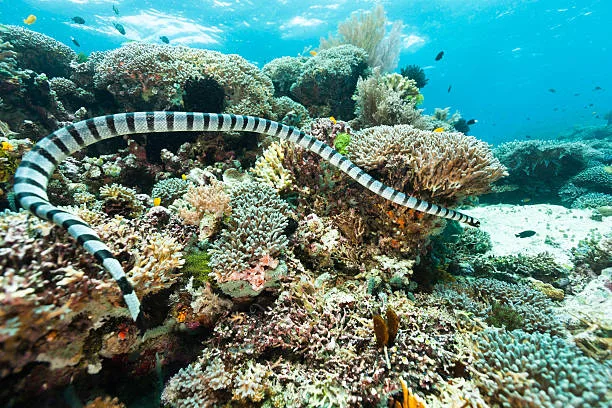
Banded sea kraits are one of the most distinctive animals in the Andaman reef ecosystem. Growing to around 60–100 cm, they move through the water in smooth, unhurried curves, hunting small fish in the crevices of the rocky reef and surfacing to breathe at regular intervals. Their bold black-and-white banding makes them unmistakable from a distance, and they tend to move through the shallower sections of the reef (4–8 m) where they are most regularly encountered by divers.
Sea kraits are highly venomous in a biological sense; their venom is adapted for immobilising fish, but they are entirely non-aggressive toward divers. Their mouths are small and rear-positioned, built for catching small fish in tight reef crevices, not for engaging anything larger. Unprovoked bites on divers are essentially unrecorded. Observe without touching, maintain a calm, slow approach, and the encounter is completely safe — and genuinely one of the most memorable wildlife moments available on a beginner dive site anywhere in India.
Topography
Snake Island is a small rocky islet — bare above the waterline, alive below it. The reef begins at 4 metres and slopes down to a sandy bottom at 12 metres, with a rocky substrate throughout that creates natural crevices, channels, and overhangs where marine life concentrates.
Best Time to Dive
Snake Island is at its best from November to May, when the Bay of Bengal settles after the monsoon and visibility opens to 10–15 metres. Water temperature at this site stays between 26–30°C throughout the season, warm enough for a thin 3mm wetsuit or even a rash guard for experienced divers. December to March offers the most consistent conditions and the best visibility. September and October can still offer good diving, but conditions are slightly less predictable as the monsoon winds down.
Marine Life at Snake Island
Beyond the sea kraits, Snake Island supports a varied reef fish community across its 4–12 m depth range. Butterflyfish move in characteristic pairs between coral formations. Schools of snappers float together in the mid-water. Parrotfish graze the reef surface, their beaks leaving distinctive scrape marks on the coral. Triggerfish patrol their reef territories, pufferfish inflate into their distinctive spherical defence posture when startled, and lionfish hover near the rock faces with their elaborate fins spread wide. Goatfish root through the sandy patches at depth, and rays rest along the sandy bottom sections where the reef meets open sand.
Sea anemones and soft corals colonise the rock face throughout the site — look inside the anemones for small clownfish taking shelter. Octopuses and nudibranchs are found in the rocky crevices and are worth seeking out with your guide's help. On occasional visits, green sea turtles have been spotted resting on the reef or gliding through the shallower sections — a memorable encounter when it happens, though not a guaranteed sighting on every dive.
Cost & What's Included
Included:
- Full scuba equipment (tank, regulator, BCD, wetsuit, fins, mask, booties, weight belt, SPG)
- Certified SSI dive guide throughout (1:1 for non-certified divers/non-swimmers)
Bring yourself:
- Certification card if certified (digital is fine)
- Swimsuit to wear under the wetsuit
- Small towel
- Reef-safe sunscreen
Getting There
Snake Island is just 800 metres from Corbyn's Cove Beach, itself approximately 8 km along a scenic coastal drive from Port Blair Airport. From Corbyn's Cove Beach, a short boat ride of around 5 minutes takes you directly to the Snake Island reef.
Emergency & Safety Information
DAN Global Emergency: +1-919-684-9111
FAQs
Snake Island takes its name from its most distinctive residents — banded sea kraits, a species of sea snake that has made this shallow rocky reef their permanent home. These are marine animals entirely, not land snakes — there are no snakes on the island itself, and you won't encounter any on the surface or on the beach. The name refers entirely to what lives in the reef below the waterline.
Banded sea kraits are venomous in the biological sense; their venom is adapted for immobilising small fish, which they hunt in rocky reef crevices. However, they are entirely non-aggressive toward divers and pose no practical danger during a normal guided dive. Their mouths are small and rear-positioned, designed for catching fish in tight spaces, not for biting anything larger. There are essentially no recorded cases of unprovoked sea krait bites on divers anywhere in the world.
Yes — Snake Island is specifically suited to beginners and non-swimmers, and the majority of divers who visit this site for the first time have no prior scuba experience. The reef starts at just 4 metres depth, conditions are calm with mild current, and the rocky reef structure gives clear, easy-to-follow visual landmarks throughout the dive. Personal instructor support at a 1:1 ratio means no swimming ability is required to stay safe and comfortable underwater.
Snake Island is a small uninhabited rocky islet sitting 800 metres off Corbyn's Cove Beach, which is approximately 8 km from Veer Savarkar International Airport. From Corbyn's Cove Beach, a short boat ride of around 5 minutes takes you directly to the Snake Island reef.
November to May is the best time to scuba dive at Snake Island, when visibility opens to 10–15 metres, water temperature stays between 26–30°C, and the sea is calmest and most reliable for sea krait activity on the reef. December to March offers the most consistent conditions and the best visibility.
Ready to Dive Snake Island?
The most convenient dive in the Andamans — a short boat ride from Port Blair, and one of the most memorable wildlife encounters you'll have underwater.