Scuba Diving at Parrot's Rock, Chidiyatapu
There is a particular kind of silence in drift diving — the moment you stop kicking and let the current take you, gliding over a reef at a pace the ocean controls. Parrot's Rock is one of the most visually arresting reef formations in South Andaman: a bare rock ribbed with ridges and channels that in places resembles a moonscape, with dense colonies of purple soft coral and tall gorgonian fans held in constant motion by the current.
Located between South Andaman and Rutland Island, Parrot's Rock is a cluster of rocks that breaks the surface at low tide — a natural landmark signalling the reef system below. The reef slopes from 5 metres at the top to 20 metres at its deepest accessible section, with the current running along the reef face giving intermediate and advanced divers an effortless, exhilarating ride.



Parrot's Rock at a Glance
About Parrot's Rock
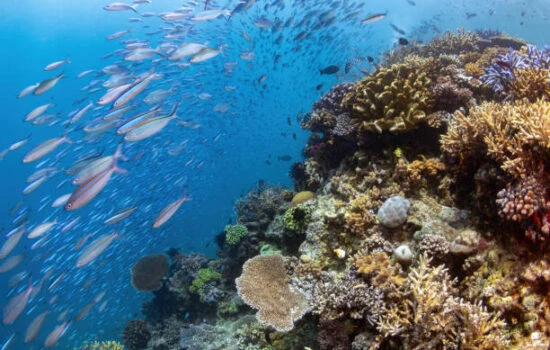
The current at Parrot's Rock is what defines the dive. Moderate to strong and running predictably along the reef face, it creates ideal drift conditions — fast enough to cover ground effortlessly, consistent enough to plan around. Your guide will brief you on current direction and speed before descent. Once in the water, you descend, neutralise your buoyancy, and the reef begins to move past you: schools of parrotfish hold formation in the current ahead, gorgonians lean toward you as you pass, and a sea turtle, unimpressed by the drift, rests on a ledge as you float by.
Parrot's Rock is the primary site for the SSI Drift Diving Specialty — one of very few locations in the Andaman Islands where consistent natural drift conditions exist for structured specialty training. If you've always wanted to experience current diving but haven't formalised the skill, ask us about completing your Drift Specialty here.
TOPOGRAPHY
This is a rocky, textured landscape — channels, ridges, and boulders of bare pale stone that give sections of the reef an almost lunar appearance. The contrast makes the bursts of colour all the more dramatic: dense clusters of purple soft coral colonise every available surface, gorgonian fan corals reach up from the deeper sections, and sea anemones anchor themselves to exposed rock faces. Swim through the channels and the landscape changes — narrower passages force the current to accelerate, then open into wider plateaus where the drift eases and you can hover and look.
Best Time to Dive
Parrot's Rock is at its best between October and April, when the Andaman Sea is calm and visibility opens to between 10 and 25 metres. Early morning dives (from around 5:10am) offer the most consistent current direction and the best underwater light for photography. Water temperature stays between 27–30°C throughout the season. December to February offers peak visibility and the most predictable drift conditions.
Marine Life at Parrot's Rock
The schooling parrotfish that give this site its name are the most visible presence — large groups feeding on the reef in the shallower sections. Alongside them, butterflyfish move in characteristic pairs, and groupers hold position in the lee of larger boulders where the current breaks. Moray eels are resident in the crevices throughout the site.
Sea turtles are a reliable presence at Parrot's Rock. Green turtles are most commonly seen resting on ledges at mid-depth (8–12 metres) or feeding on the soft coral.
Cost & What's Included
Included:
- Full scuba equipment (tank, regulator, BCD, wetsuit, fins, mask, booties, weight belt, SPG)
- Power masks available on request (-2 to -8)
- Boat transfer to and from Parrot's Rock
- Certified SSI dive guide throughout
Bring yourself:
- Certification card (digital is fine)
- Swimsuit to wear under the wetsuit
- Small towel
- Reef-safe sunscreen
- Light snacks
Getting There
Parrot's Rock is located between South Andaman and Rutland Island, accessed from Chidiyatapu at the southern tip of South Andaman — approximately 40 minutes by road from Port Blair, followed by a short boat transfer to the site. This is a boat-access-only drift dive; there is no shore entry.
Emergency & Safety Information
DAN Global Emergency: +1-919-684-9111
FAQs
Drift diving is a style of scuba diving where instead of swimming against or across a current, you let the water carry you. You descend, neutralise your buoyancy, and the current does the work — moving you along the reef at a natural pace while you focus entirely on what you're seeing. There's no fin kicking, no effort, no fighting the water; experienced divers often describe it as flying. At Parrot's Rock specifically, the current runs along the reef face in a consistent direction, taking you past the site's most dramatic features: moonscape rock formations rippled with channels and ridges, sudden explosions of purple soft coral, tall gorgonian fan corals leaning into the current, and open sections where schools of parrotfish hold formation ahead of you. The entire dive covers more ground than a standard dive at the same depth, and it feels effortless throughout.
The drift dive at Parrot's Rock requires a minimum Intermediate or Advanced Open Water certification (SSI or PADI equivalent). The moderate to strong current and 20-metre maximum depth mean divers need solid buoyancy control and comfort in the water before attempting the site. We recommend at least 15–20 logged dives before your first drift dive here. The reef is not suitable for beginners and non-swimmers.
Yes — Parrot's Rock is the primary site for the SSI Drift Diving Specialty, one of very few locations in the Andaman Islands with the consistent natural current conditions required for proper specialty training. This is a genuine advantage of diving at Chidiyatapu rather than Havelock, where current-driven sites are less reliable. The specialty teaches you how to plan and execute drift dives safely: reading and using currents to your advantage, managing your position relative to the reef and your buddy, using an SMB (surface marker buoy) to signal your position when surfacing away from the entry point, and communicating with your boat in open-water current conditions. The course requires a minimum Open Water certification and is completed over two dives at the site.
Parrot's Rock is diveable from October to April. During this period, visibility regularly reaches 20–25 metres, the current is at its most consistent, and the soft corals and gorgonians are at their healthiest and most vivid. If you have flexibility in your Andaman itinerary, a December or January booking delivers the best possible drift experience.
Parrot's Rock is located between South Andaman and Rutland Island, accessed from Chidiyatapu at the southern tip of South Andaman — approximately 40 minutes by road from Port Blair, followed by a short boat transfer to the site. This is a boat-access-only drift dive with no shore entry.
Drift diving is safe when conducted with proper preparation, training, the right equipment, and an experienced guide. The main safety consideration unique to drift diving is that the current moves you along the reef, so you may surface at a different point from where you entered — this is entirely normal and planned for. Drift divers at Parrot's Rock use an SMB (surface marker buoy), a brightly coloured inflatable tube deployed from underwater before you ascend, which signals your precise location to the boat crew above; they track the SMB and move the boat to your position, so you're never left to surface and search for the boat. We brief all divers on the SMB procedure during the pre-dive briefing and carry a spare on every dive. In the unlikely event of separation from the group, standard dive protocol applies: ascend slowly, deploy your SMB, remain on the surface, and wait for the boat.
Ready to Drift?
Let the current carry you past moonscape rock formations, purple soft coral, and resting sea turtles — one of South Andaman's most exhilarating dives.