Jackson's Bar — Current-Swept Plateau & Pelagic Life at Havelock Island (Swaraj Dweep)
Jackson's Bar, Dixon's Pinnacles, and Johnny's Gorge share more than a reputation; they share a family. The three dive sites are named after three brothers from Havelock Island's Karen community: descendants of a Burmese tribe brought to the Andaman Islands by the British East India Company in the 1920s and 1930s to work in the islands' deep forests. Jackson, his brother Johnny, and his brother Dixon became divemasters and, between them, discovered three of the greatest advanced dive sites in the Andaman Sea.
Jackson discovered the elongated rocky plateau northeast of Havelock that now bears his name — a large, long rocky shelf where a strong perpendicular current concentrates pelagic life: tuna and barracuda cruise the mid-water, eagle rays and manta rays follow the current lanes to the plateau's cleaning stations, and whitetip reef sharks patrol the shelf edge.



Overview of Jackson's Bar (Quick Facts)
About Jackson's Bar Dive Site
Jackson's Bar is a large and long rocky shelf — a "bar" of rock extending from the sandy bottom at 30–35 metres, the current flowing perpendicular across it. The strong perpendicular current that runs across the plateau brings pelagics: tunas and barracudas cruise the mid-water, using the current's concentrated nutrients; eagle rays and manta rays follow the current lanes to the plateau, where cleaning stations operate; whitetip reef sharks patrol the shelf edge.
The current can be strong, which is why Jackson's Bar is for advanced divers with solid buoyancy control and drift diving experience. The best strategy is to position behind the bar structure on descent, using the rock as a current break, then move to the current-exposed edge when ready. Your guide will brief the current direction and strength before entry, and will plan the dive route to place you at the most productive sections of the reef.
Topography
Jackson's Bar is a large strip of rock extending from the bottom at 30–35 metres. The "bar" in Jackson's Bar refers to the elongated, linear formation of the reef — a rocky shelf or plateau that extends directionally across the sandy bottom like a sandbar, but composed of solid rock rather than sediment. The reef is naturally designed in a bar-like formation, where current flows across it perpendicular to this bar. The reef concentrates pelagic fish above the structure and gives the site its distinctive character. The plateau top sits at approximately 20–25 metres; the surrounding sandy bottom is at approximately 30–35 metres.
Best Time to Dive
November to March offers the most consistent current and the best pelagic activity probability at Jackson's Bar, with dive slots from 5:10am to 1:30pm. Early morning slots maximise the probability of the strongest tidal current window coinciding with your dive. Visibility is typically 15m+ and can reach 30m in peak conditions. Water temperature stays 26–29°C year-round.
Marine Life at Jackson's Bar
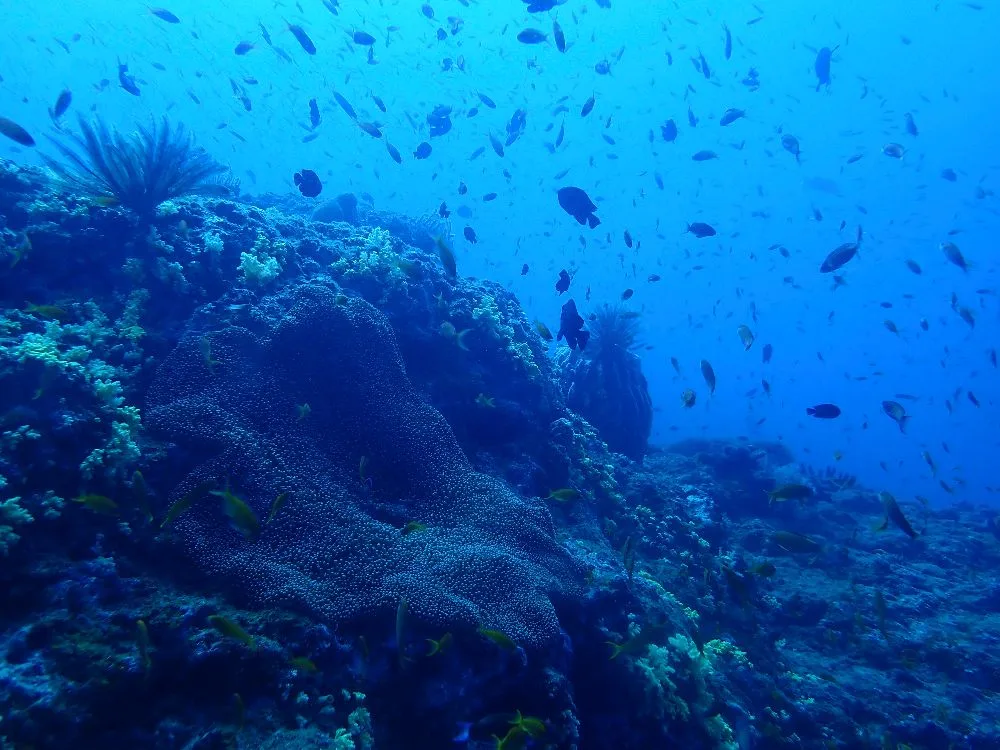
Above the plateau: schools of Bengal snappers, Andaman sweetlips, tuna, and barracuda can be seen on all days. Eagle rays, stingrays, and sharks visit the cleaning stations on the plateau top. Manta rays are occasional but more reliably seen at this reef than most Havelock deep sites. Napoleon wrasse patrol the plateau perimeter, large potato groupers rest at the base of the structure sheltering from the current, and fusiliers fill the water column above in dense schools that attract the tuna and barracuda from the open water.
In the plateau's overhangs and crevices, banded sea kraits shelter for feeding and frequently approach divers with unhurried curiosity. Java eels occupy the deeper crevice sections, and lionfish and scorpionfish hold position in the low-current overhang sections. On the sandy base surrounding the plateau, garden eel colonies emerge from burrows in swaying formations, and Kuhl's stingrays rest in the open sand beside the bar structure, partially buried and visible by their distinctive blue-spotted pattern. Sea turtles are occasional visitors, resting on the plateau surface or gliding past in the open water above.
Cost & What's Included
Included:
- Full scuba equipment for both dives (tanks, regulator, BCD, wetsuit, fins, mask, booties, weight belt, SPG)
- Certified SSI dive guide throughout
Bring yourself:
- Certification card (digital is fine)
- Swimsuit to wear under the wetsuit
- Small towel
- Reef-safe sunscreen
- Optional extras: underwater camera, surface marker buoy, rash guard, dive computer
Getting There
The reef is easily accessible by a 45–60 minute speedboat ride from Govind Nagar Beach-03 and lies 19km offshore, northeast of Havelock Island. We offer complimentary pickup and drop-off within a 5km radius of our dive shop.
Emergency & Safety Information
DAN Global Emergency: +1-919-684-9111
FAQs
The current at Jackson's Bar is the strongest amongst Havelock dive sites and can accelerate at times, depending on the moon and tide conditions. This is why Jackson's Bar is an advanced-only site and specifically not suitable for Open Water certified beginners, regardless of the number of dives. The current is not dangerous in the sense of being unpredictable or unmanageable for an experienced diver; it is directional and consistent, running perpendicular to the bar formation.
Banded sea kraits are among the most distinctive and frequently spotted animals at Jackson's Bar. They are sea snakes with a vivid black-and-white banded pattern that makes them unmistakable underwater. They grow to approximately 1-1.5 metres in length. They are venomous, but they are genuinely non-aggressive toward divers. In decades of diving in Andaman waters, banded sea krait bites to divers are essentially unheard of when standard protocol is followed.
Garden eels rush to their burrows quickly and simultaneously when a diver approaches. The entire colony disappears into the sand in a wave that moves across the colony as the disturbance approaches. This retraction behaviour is triggered by size and movement; the garden eels cannot distinguish between a diver and a predator.
Jackson's Bar requires a minimum Advanced Open Water (AOWD) certification. This is because the reef starts at 20-25 metres minimum depth, which is beyond the standard Open Water certification depth limit of 18 metres. The strong perpendicular current makes position management, drift diving experience, and buoyancy control demands that are genuinely beyond what an Open Water course prepares a diver for.
Certified divers pay INR 8,000 + 18% GST per person, which covers the two dives typically needed at this site.
Your dives include scuba tanks, weight belt, regulator, submersible pressure gauge, buoyancy compensator, wetsuit, mask, fins, and booties. Bring your own swimwear to wear under the wetsuit, a small towel, and reef-safe sunscreen. An underwater camera, surface marker buoy, rash guard, and dive computer are optional extras worth carrying if you have them.
Ready to Dive Jackson's Bar?
The third of Havelock's Holy Trinity — a current-swept rocky bar bringing tuna, barracuda, eagle rays, manta rays, and whitetip sharks within reach of one dive plan.