Bus Stop — Coral Gardens & Garden Eels on Neil Island
Bus Stop is named for the way reef fish converge and rest here — schools of groupers, sweetlips, and damselfish use this as their meeting point, just as commuters gather at a bus stop. Located 3km west of Neil Island, it's one of the most popular reefs between Neil Island and Havelock, and it has a structural feature that sets it apart from almost every other dive site in the Andamans.
The reef extends outward in all four directions from the central mooring point — north, south, east, west, each offering a different underwater experience. This makes Bus Stop one of the most versatile dive sites on Neil Island, where no two dives are identical and where Open Water students, intermediate divers, and advanced divers can all be in the water at the same time with fundamentally different dive plans.



Overview of Bus Stop (Quick Facts)
About Bus Stop Dive Site
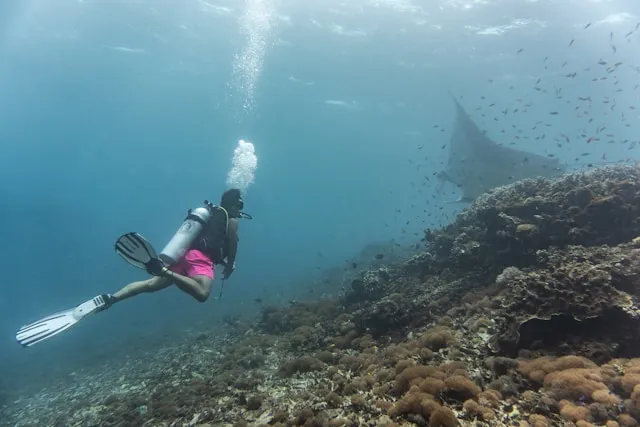
The gradually sloping bottom at Bus Stop, with its smooth depth progression from 13m to 20m, makes it one of the best Neil Island sites for buoyancy practice and multi-level diving skills. Open Water students can work on neutral buoyancy at multiple depth points during the same dive without abrupt depth changes. Advanced divers can use the four-directional structure to plan multi-level dives that cover different depth zones in a single session. The manageable current on most days allows both groups to focus on technique rather than fighting the water.
Topography
The reef structure is a gently sloping fringing reef built from small scattered rock patches on a sandy bottom, extending outward from the mooring in all four directions. To the north, a beautiful formation of rocks creates natural overhangs and crevices. To the west, a small downward-sloping plateau carries divers from the shallower soft coral zones into the deeper branching coral sections. The upper sections of the slope (around 13–15m) are carpeted with patches of soft coral.
The deeper sections reveal Bus Stop's strongest character: massive and branching corals covering the sandy bottom, fan corals extending wide from the rocky sections, and sandy patches between the reef scattered with garden eel colonies and blue-spotted stingrays.
Best Time to Dive
Bus Stop is most suitable from October to May, when visibility typically ranges from 15 to 20 metres in season. Neil Island's lack of mangrove run-off keeps the water bluer and clearer than Havelock on comparable days. Water temperature stays 25–30°C year-round. Current at this site is generally mild, making it suitable for a wide range of certified diver experience levels. December to February offers the most consistent conditions.
Marine Life at Bus Stop
The "Bus Stop" character is evident the moment you descend — schools of fish congregate here with a density that distinguishes this site from most Neil Island reefs. Groupers swim in formations in the mid-water. Sweetlips hover in clusters near the coral sections. Damselfish, angelfish, and butterflyfish populate every level of the reef in different directions from the mooring.
On the sandy sections between reef patches, garden eel colonies are one of Bus Stop's most distinctive sightings — dozens of slender eels extend from the sand in swaying formations. Blue-spotted stingrays rest in the sandy openings between the rock patches throughout the depth range. Lobsters peer from rocky crevices across the site.
The coral diversity at Bus Stop is among the richest of any Neil Island dive site. Staghorn coral dominates sections of the shallower reef. Fan coral extends wide from rock faces in the deeper sections. Brain coral presents its unmistakable maze-like dome surface at mid-depth. Table coral, mushroom coral, cauliflower coral, and open brain coral complete a coral species list that rewards a slow, observational dive as much as a wide-ranging exploration.
Cost & What's Included
Included:
- Full scuba equipment (tank, regulator, BCD, wetsuit, fins, mask, booties, weight belt, SPG)
- Power masks available (-2 to -8) on request
- Certified SSI dive guide throughout
Bring yourself:
- Certification card (digital is fine)
- Swimsuit to wear under the wetsuit
- Small towel
- Reef-safe sunscreen
Getting There
Bus Stop is accessible via a 10-minute boat ride from the shoreline, lying 3km off the western coast of Neil Island. We offer complimentary pickup and drop-off by AC car for participants staying between Laxmanpur Beach and Bharatpur Beach; paid transportation is also available from Sitapur Beach.
Emergency & Safety Information
DAN Global Emergency: +1-919-684-9111
FAQs
Scuba divers can explore a variety of fish life at Bus Stop, including schools of groupers, sweetlips hovering in clusters near the coral sections, damselfish darting throughout the reef, angelfish moving in their characteristic pairs through the mid-water, and butterflyfish following the coral edge at every depth.
Bus Stop is a certified-divers site (Open Water qualified or above). The gently sloping bottom and minimal current make it a genuinely good site for Open Water students working on buoyancy control, and certified intermediate to advanced divers can explore the full slope, including the branching coral sections at 18–20 metres. The 13–20 metre depth range means it isn't offered to non-certified beginners or non-swimmers.
Garden eels are one of the most rewarding species at Bus Stop and one of the most challenging to observe for more than a second. The best technique for sustained observation: descend slowly before you reach the colony (not directly above it), approach horizontally rather than vertically downward, and stop at a distance of 3–4 metres.
Visibility at Bus Stop typically ranges from 15 to 20 metres in season, with December to February offering the most consistent clarity. Neil Island's lack of mangrove run-off keeps the water notably bluer and clearer than Havelock Island on comparable days. The mild current also makes it a good site for photography, where subjects stay still enough to be captured properly.
Bus Stop is most suitable from October to May, when visibility typically ranges from 15 to 20 metres in season. Water temperature stays 25–30°C year-round, and December to February offers the most consistent conditions.
Your dive includes a buoyancy compensator, wetsuit, mask (power masks -2 to -8 available on request), fins, booties, scuba tank, weight belt, regulator, and submersible pressure gauge. Bring your own swimwear to wear under the wetsuit, a towel, and reef-safe sunscreen for the boat transit.
Ready to Dive Bus Stop?
A four-directional reef rich in garden eels, stingrays, and coral diversity — one of Neil Island's most versatile dives for certified divers of every level.